What is FGM/C?
FGM/C comprises all procedures that involve the partial or total removal of the external female assigned genitalia, or other injuries to the female assigned genital organs, for non-medical reasons. It is recognized internationally as a human rights violation, torture, and an extreme form of violence against women and girls, and it is usually performed between birth and puberty.
Taking Action in MassachusettsUnderstanding FGM/C
The World Health Organization(WHO) outlines four major categories of FGM/C. In general, these four categories are very broad and range from the least physically severe to the most physically severe in terms of the type of FGM/C that occurs.
Training and Technical Assistance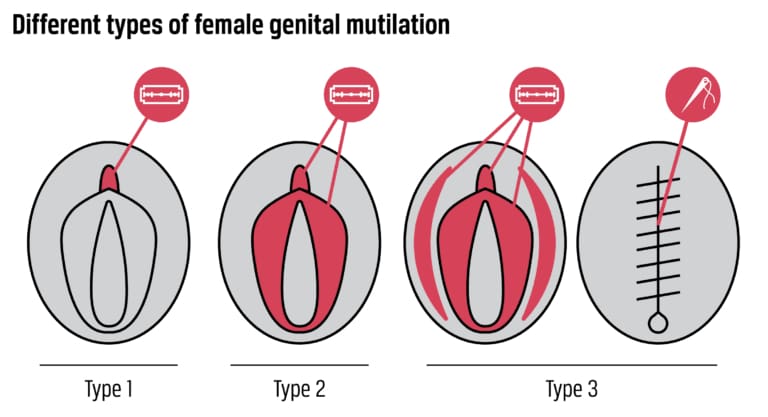
Jenson, C & Friedbaum, E. Female Genital Cutting in Africa. Ballard Brief. 2018.
Four Major Types of FGM/C
Type I
Excision (removal) of the clitoral hood with or without removal of part or all of the clitoris
Type II
Partial or total removal of the clitoris and the labia minora, with or without excision of the labia majora (excision).
Type III
Narrowing of the vaginal orifice with creation of a covering seal by cutting and appositioning the labia minora and/or the labia majora, with or without excision of the clitoris (infibulation).
Type IV
Other – including pricking, piercing, cauterizing, etc
Global & National Prevalence
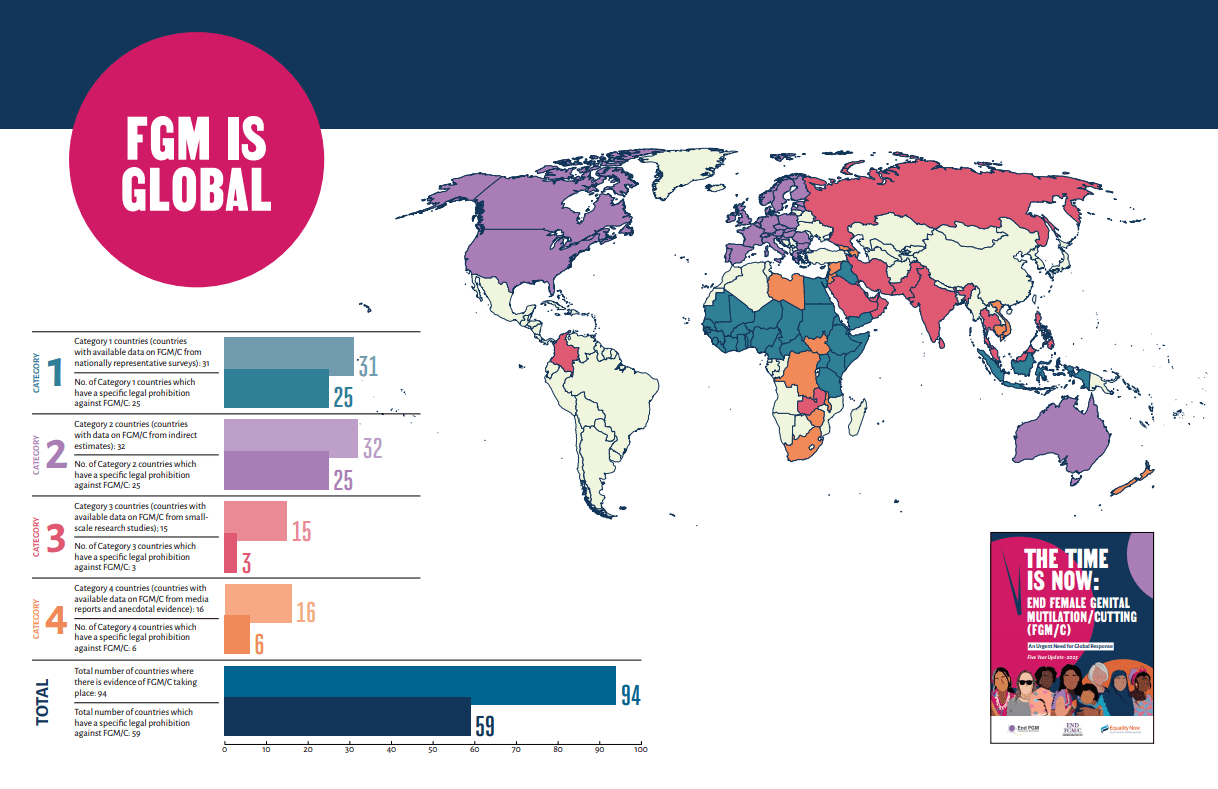
According to UNICEF, at least 230 million girls and women alive today have undergone FGM/C in only 30 countries in Africa, the Middle East, and Asia. However, considering that FGM/C has been documented in over 94 countries worldwide and on every continent except for Antarctica, we understand this number to be severely underrepresented and the true number to actually be much higher.
Understanding FGM/C Prevalence
A 2016 study by the Centers for Disease Control and Prevention (CDC) estimates that FGM/C impacts over half a million women in the U.S. However, it’s worth noting that these estimates are under-representative of the true figures of individuals impacted by FGM/C, given that these figures are based on immigration patterns to the U.S. from only 32 countries (largely from sub-Saharan Africa, where UNICEF collects data on FGM/C).
Knowing that FGM/C has been documented in over 94 countries globally, including the United States, we know that the data is not comprehensive enough, leading us to believe that the current estimates are underrepresented.
Massachusetts Prevalence
According to a 2013 Population Reference Bureau study, 14,211 women and girls in the state of Massachusetts have been affected by FGM/C. According to a more recent study conducted by Sean Callaghan, Head of Research at Orchid Project, from 2015-2019, 9,416 women and girls were likely living with FGM/C, and 697 girls were likely at risk of undergoing FGM/C in Massachusetts.
FGM/C occurs in communities of various backgrounds, including socioeconomic status, education level, race/ethnicity, religion, and more, including in both diaspora and non-migrant communities.
MA Coalition