The Strategy Behind Hollistic Organized Partnership to End FGM/C in MA’s Coalition Work (HOPE MA)
Posted On: 01-05-26
According to a 2013 Population Reference Bureau study, 14,211 women and girls in the state of Massachusetts have been affected by FGM/C. Addressing FGM/C in Massachusetts and supporting survivors is the critical challenge at the center of Holistic Organized Partnerships to End FGM/C in MA (HOPE MA). It requires systems coordination to align healthcare, education, policy, and community voices. In envisioning HOPE MA’s process to address these complex connections, the project team needed tools that could bring clarity to the process, leverage collaboration, and keep survivors at the center of the work.
Visually compelling graphics are powerful in their ability to break down complex connections and illustrate anchoring principles. HOPE MA’s Theory of Change and Stakeholder Map are exemplary models of opportunities to distill the systems coordination of HOPE MA into accessible and interactive visuals.
Our Systems-Based Theory of Change (ToC)
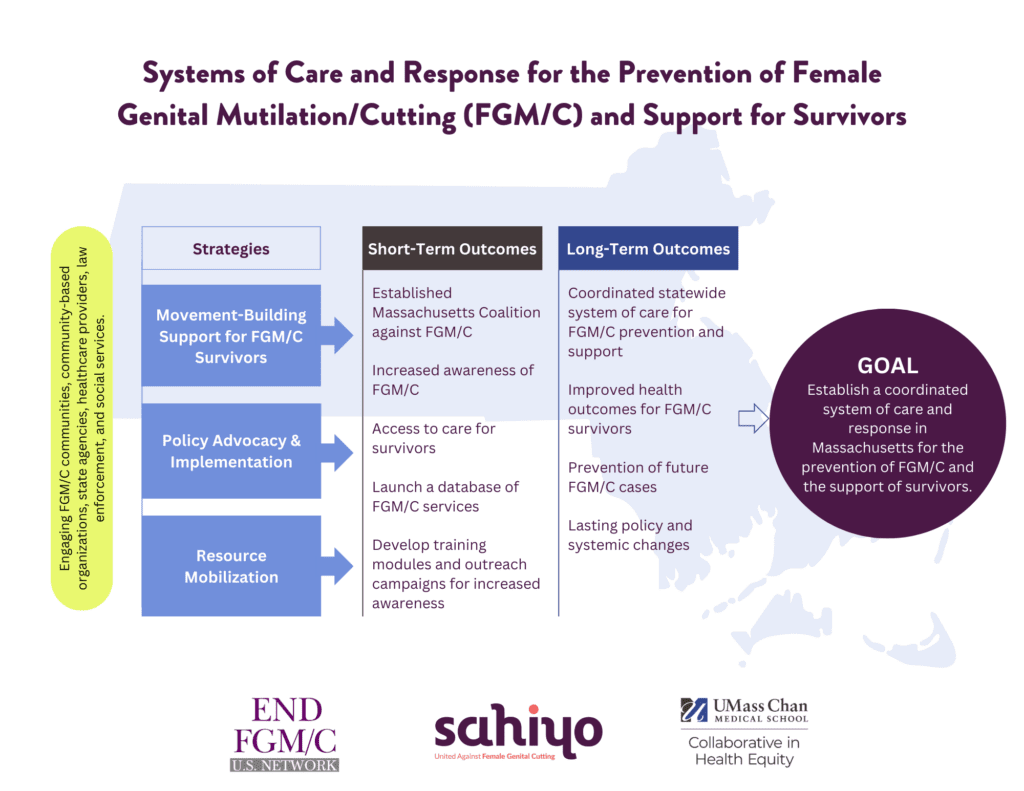
Our Theory of Change came first from a fundamental question: How do we move from fragmented responses to a truly coordinated statewide system? We needed to articulate not just what we hoped to achieve, but how the pieces would connect.
The framework identifies three strategic pillars, Movement-Building Support for FGM/C Survivors, Policy Advocacy & Implementation, and Resource Mobilization. Each element works towards both short and long-term change.
HOPE MA’s Theory of Change is rooted in the wisdom that lasting progress begins with trust. Building genuine relationships with affected communities, fostering coordination across systems that rarely connect, and openly addressing power imbalances are the foundation of how we aim to manage cross-sector partnerships. While this is an ongoing process, naming these commitments keeps us accountable and reminds us that transformation is a long-term process.
Our Theory of Change has helped us see the full scope of what this work requires. It spans from establishing a statewide coalition and raising awareness among service providers to launching a database of services and developing survivor-informed training. Together, these efforts build toward our ultimate vision, a coordinated system where survivors experience better health outcomes, and where prevention, education, and community advocacy reduce the risks of FGM/C for future generations.
The Stakeholder Map as a Living Tool
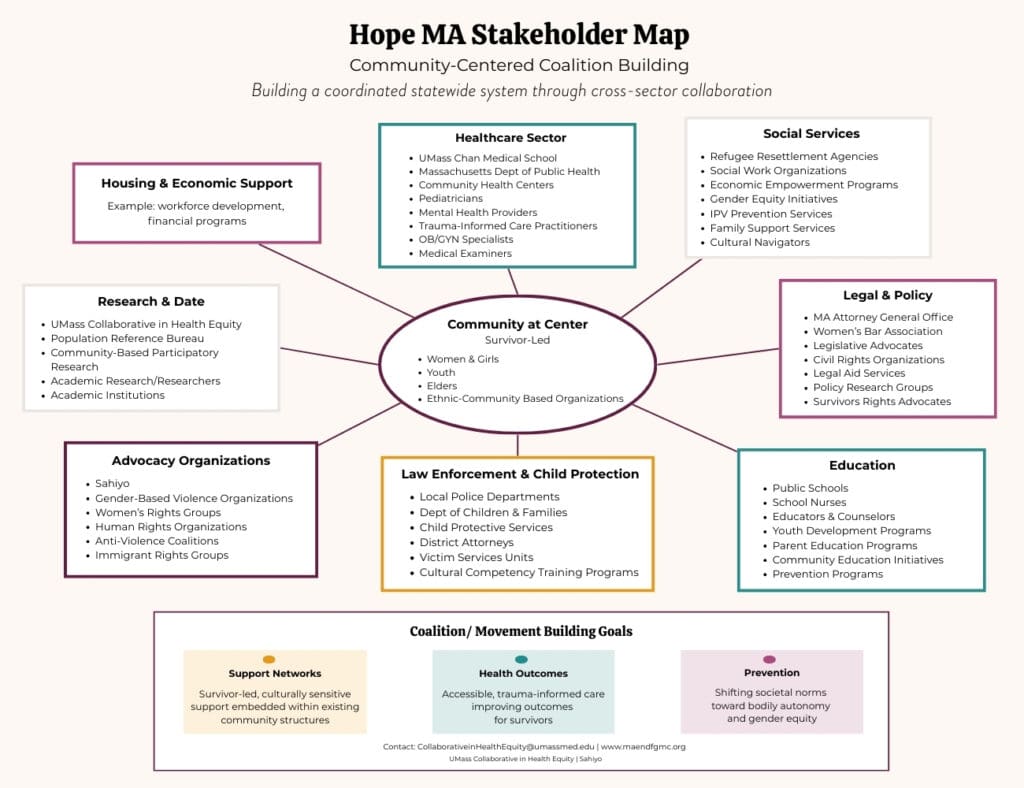
When HOPE-MA presented at the Massachusetts Nonprofit Network conference on “Building Bridges & Creating Change: Community-Centered Approaches to Multi Sectoral Movement Building.” The Stakeholder Map took shape because we wanted to show how coordination across sectors can actually happen and create something others could use in their own work.
Designed as an interactive exercise, it helps participants identify essential roles across sectors while keeping community at the center. In our context, that means emphasizing our aim to build a survivor-led movement that prioritizes those most impacted to lead solutions through engaging women and girls, youth, elders, and ethnic community-based organizations.
Radiating outward are interconnected sectors including healthcare, social services, education, legal and policy, law enforcement and child protection, advocacy, research and data, and housing and economic support. Each plays a distinct role, but the map shows how they must work together to create lasting change.
The Stakeholder Map is intended as a living document that grows and adapts. It helps our coalition and others prioritize, brainstorm connections, and examine power dynamics. At the conference, participants from different movements mapped their own centers, sectors, and rings – making this more than a diagram but a strategic tool in visioning movement building and collective power.